1.10 Latent Heat of a Thunderstorm
It is amazing how much energy is released in a thunderstorm just from the rain generated. This activity will explore an algorithm for determining just how much energy is released.
Essential Question(s):
Essential Question(s):
- How is energy tansferred through water vapor?
- Define steps to determine energy released from a thunderstorm.
Instructional Notes
No Plan Available
Instructions
Follow directions provided below.
Background: The picture says it all, or at least enough to do this activity. There are conflicting numbers from other sources that indicate the heat of evaporation is 540 cal/g (2260 J/g). See link. The evaporation of water over the equater (i.e., oceans) causes an increase of kinetic energy of the H2O molecules. These water molecules are in turn carried to Northern or Southern latitudes. Later in the upper latitudes, the water vapor condenses into rain drops reducing the kinetic energy of the H2O molecules. Due to the Law of Conservation of Energy, this energy must be transfered to the kinetic energy of what remains in the atmosphere (e.g., O2, N2, Ar, CO2). Hence, the energy pathway follows:
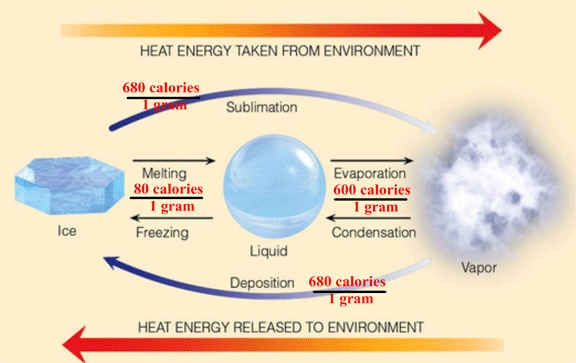
There are specific steps in calculating how much energy is released into the surrounding air when rain is generated from a thunderstorm. In this task you will be expected to not only follow instructions, but also help generate the instructions needed to accomplish the task.
1. Open a new Word document to write the instructions.
2. Open the WxScope file that already has data selected for a thunderstorm in SE Oklahoma.
3. Now it is your turn... follow remaining verbal instruction in class as they are modeled. Once Sacket is done modeling, each student should also be done.
4. When done, upload both the Word doc with instructions AND the modified WxScope file used to determine rain values.
- Solar energy @ equator to
- Evaporation of liquid water to water vapor (increase KE) (lower latitudes) to
- Condensation of water vapor to liquid water (decrease KE) (upper latitudes) to
- Increase KE (increase temperature) to environment (surrounding air)
Terms to Know:
|
Skills to Demonstrate:
|
What to do:
There are specific steps in calculating how much energy is released into the surrounding air when rain is generated from a thunderstorm. In this task you will be expected to not only follow instructions, but also help generate the instructions needed to accomplish the task.
1. Open a new Word document to write the instructions.
2. Open the WxScope file that already has data selected for a thunderstorm in SE Oklahoma.
3. Now it is your turn... follow remaining verbal instruction in class as they are modeled. Once Sacket is done modeling, each student should also be done.
4. When done, upload both the Word doc with instructions AND the modified WxScope file used to determine rain values.